Oven Repair
Wolf oven running cold: why everything bakes pale and slow
A Wolf oven that reads 375 but bakes like 320 is almost never a dead oven. Here is how to confirm the drift, what the usual cause is on dual-fuel and all-gas cavities, and the point at which it needs a technician.
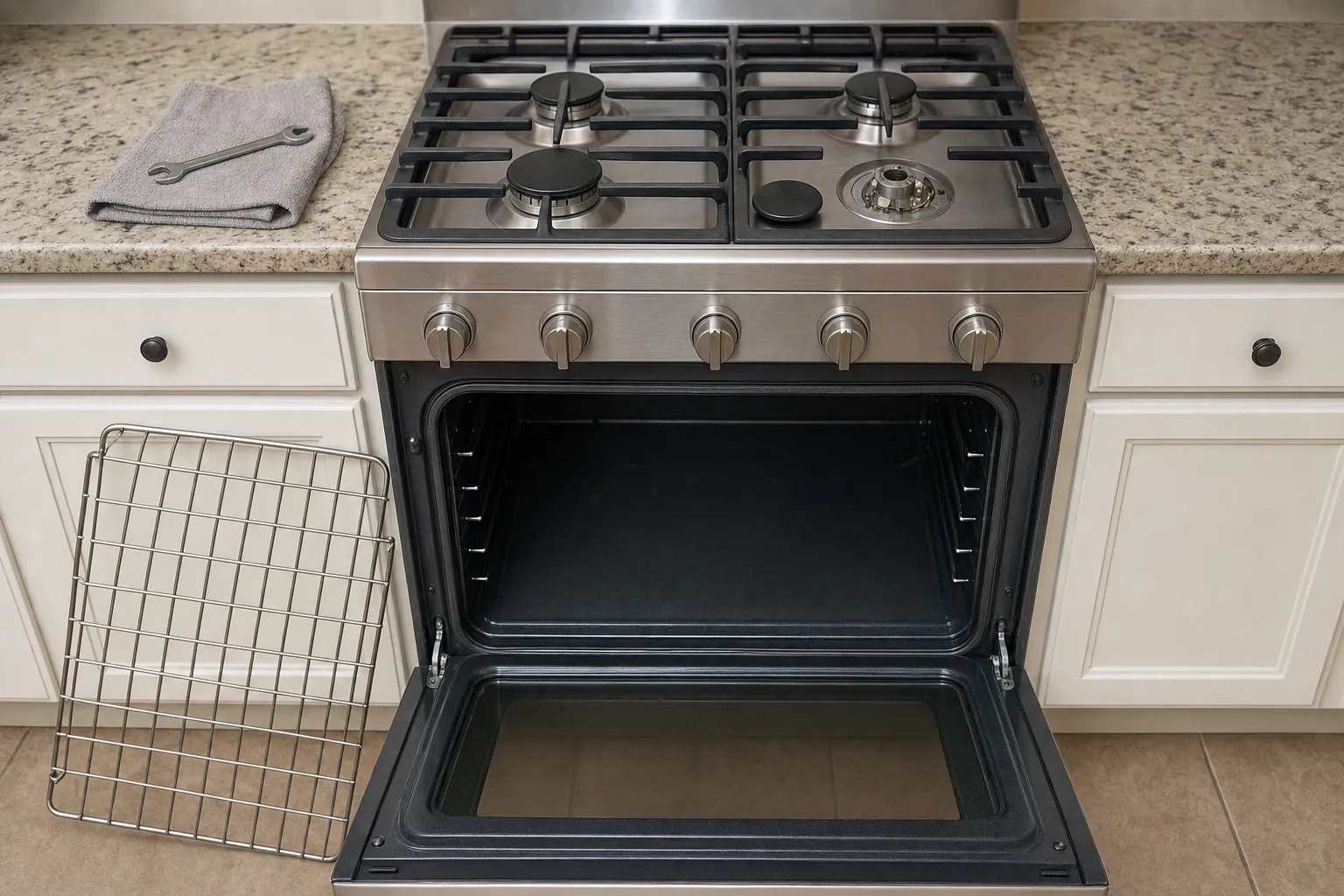
An oven that is 60 degrees cold does not announce itself. It shows up as sponge cakes that stay pale, roast potatoes that never crisp, and a bake time that has quietly crept up by fifteen minutes over a couple of years. By the time most people in Woodinville call about it, they have already adjusted their recipes around the fault twice.
The good news is that a Wolf cavity running cold is one of the most tractable faults on the appliance. It is nearly always a measurement problem or a heating-element problem, and both are diagnosable in an hour with a probe and a meter. What it is almost never is a reason to replace the range.
Confirm the drift before you touch anything
Buy or borrow an oven thermometer — a dial one hung from a rack is fine, an instrument probe is better. Set the oven to 350°F on Bake, no convection, and leave it alone for a full twenty-five minutes. Ovens overshoot and undershoot while they settle, so a reading taken at eight minutes tells you nothing.
Then read it every five minutes for another twenty. You are looking for two numbers: the average, and the swing.
- Average close to 350, swing of 20 either way. Normal. The oven is cycling as designed and your bake times are a recipe problem, not a hardware one.
- Average 20 to 30 low, tight swing. Calibration drift. Wolf cavities have a user offset in the control menu, and this is exactly what it is for.
- Average 40 or more low. A fault. Offsetting this hides it rather than fixing it.
- Wild swing, 60 degrees or more between peaks and troughs. The sensor or the control relay is misreporting. Stop here and call.
Write the numbers down. A technician who arrives already knowing the cavity holds 295 when asked for 350, with a tight swing, has skipped a third of the diagnostic.
What is actually failing
On a dual-fuel range or an electric wall oven, the cavity is heated by bake and broil elements under electronic control, with a temperature sensor — a resistance probe, not a thermocouple — reporting back. Three things go wrong, in this order of frequency.
The oven sensor drifts. It is a resistor whose value changes with heat, and after years of thermal cycling its curve shifts. It still works, it still reports, it simply reads high. The control believes the cavity has already reached temperature and cuts the heat too soon, so everything bakes pale. The part is inexpensive and the swap is straightforward.
A bake element fails partially or completely. A fully open element is obvious: the oven barely warms and the broil element does all the work from above, browning the top of everything while the base stays raw. A partial failure is subtler — the element still glows, but not evenly along its length, and the cavity never quite gets there.
The relay on the control board sticks. Less common, more expensive, and usually accompanied by other symptoms: an element that stays on when it should not, or a cavity that overshoots badly before crashing back.
On an all-gas cavity, the picture changes. Here you are looking at the oven burner igniter. A weak glow-bar igniter is the single most common cause of a gas oven that underperforms — it still glows, so it looks fine through the vent, but it has stopped pulling the current the gas valve needs before it will open. The burner lights late, cycles short, and the cavity averages cold. An igniter that looks perfectly healthy can still be out of spec; the test is a current draw reading, not a visual check.
Things worth ruling out yourself
Before anyone drives over, three of these take five minutes each.
Is convection involved? A convection bake cycle on a Wolf automatically reduces the set point, because moving air cooks faster. If your comparison was a convection recipe run on standard bake, the oven is behaving correctly and the recipe is not.
Is the door sealing? Run a hand around the closed door on a hot oven. A flattened or torn gasket bleeds heat continuously and the cavity compensates by running the element longer — which usually reads as an oven that struggles rather than one that is cold, but on a badly deteriorated seal it presents identically. Look for a gasket that has gone hard, or a corner that no longer sits in its channel.
Has the calibration already been changed? More than once we have found an oven with a large negative offset dialled in years ago by a previous owner or a previous technician, papering over a sensor that has since been replaced. Check the offset is zero before assuming the hardware is at fault.
What a proper diagnosis looks like
A technician should not open with a parts recommendation. The sequence is: probe in the cavity to establish the real temperature against the set point, resistance check on the oven sensor at known temperatures against the manufacturer curve, continuity and current draw on the elements or the igniter, then the control board’s own stored fault log.
That order matters, because the cheapest part is checked first. Replacing a sensor on suspicion is a common shortcut, and it is right often enough that it gets away with it — but when it is wrong, the customer has paid for a part that was fine and still has a cold oven.
Expect to be shown the readings. “The sensor measures 1180 ohms at a cavity temperature where it should read 1090” is a diagnosis. “It is probably the sensor” is a guess.
When to stop using it
A cold oven is an inconvenience, not a hazard, with three exceptions. If you can smell gas at any point in the cycle, shut the appliance off at the supply and call — that is not a temperature fault. If the burner or element cuts out repeatedly mid-bake and the panel throws a code, the safety circuit is intervening and it should be left alone until it is looked at. And if there is any smell of hot insulation or scorched wiring, stop.
Otherwise, cook by thermometer and book a visit when it suits you. Almost every cold-cavity job we take in Woodinville comes down to one part and one afternoon, and the appliance goes back to holding its set point for another decade.
Common follow-ups
How far off is 'normal' for a Wolf oven?
A swing of roughly 15 to 25 degrees either side of the set point during a cycle is normal — that is the thermostat doing its job. A steady average that sits 40 degrees or more below what you dialled in is a fault, not a characteristic.
Will recalibrating the oven fix a cold cavity?
Only if the drift is small and steady. Calibration offsets are designed to correct 10 to 15 degrees. Using an offset to mask a 60-degree shortfall hides a failing sensor or element and usually makes the eventual failure harder to trace.
Can I keep using an oven that runs cold?
If the cavity still reaches a stable temperature and nothing smells of gas or burning insulation, yes — bake by thermometer rather than by dial in the meantime. If the burner or element is cutting out mid-cycle, stop using it and get it looked at.